• RSS
  • Delicious
  • Digg
  • Facebook
  • Twitter
  • Linkedin
  • Youtube
Showing posts with label Goodreads. Show all posts

The 10 Commandments of Social Media Etiquette for Writers


When I wrote a couple of weeks ago about the importance of commenting on blogs to raise your social media profile, I forgot to say one essential thing—probably because I figured it's something your mom told you—but for those who've forgotten, here it is…

If you don't have anything nice to say, don't say it.

That's true even in a thread where a lot of people are being snarky and you're simply going along with the crowd. I've done it myself and ended up hurting good people's feelings. Remember when you're online, you're "in public" and anybody can see what you've written. 

If you're planning to publish traditionally, the reason to follow mom's rule is simple. Editors and agents will Google you (often before they decide to read your pages) and if they find a bunch of nasty Tweets, forum flames, and bullying blog comments, your career is going nowhere.

Why do they Google you before reading your writing sample? The same reason any prospective employer Googles you. Most people prefer to work with level-headed, rational human beings who are not prone to drunk-posting, dissing their co-workers, or dancing naked with tighty-whiteys on their heads. Just the way it is.

Remember, "free speech" means you have a right to say what you want in public (not necessarily on private property) but it does NOT shield you from the consequences of what you say. 

Even if you self-publish, or are planning to—establishing a reputation for being nasty, closed-minded, or self-centered can still damage your career. The indies who do best are the ones who respect fans, guest blog, do joint promotions, and generally play well with others.

It's fine to disagree and/or add new information to a discussion—in fact, that's a great way to raise your profile—but do it like a grown-up, civilized human, not an entitled adolescent with a vocabulary limited to barnyard words.

The tech world was invented by young, rule-breaking types, mostly males. So an early Internet culture evolved that tended to be adversarial, snarky, and intolerant of newbies—more like posturing teenagers than adults doing business.

But the publishing world is the opposite. It's a business that has always been powered by the gentlemanly art of the schmooze.

Making people angry may drive people to your blog, and you may hear that "troll posts" and creating controversy is a way to get traffic. But it's probably not the kind of traffic you want, even if you self-publish.

Remember everything you do or say online is public. That includes your snarky @tweets to your BFF (DM instead) and those party photos your idiot friend took at the Mardi Gras party and posted to FB (ask him politely to take down that tighty-whitey photo, or "untag" you.)

So here are ten tips for online behavior for people planning a writing career. (Unless your life goal is to be a professional extremist ranter—then ignore everything here. Being a person people love to hate can make you rich and famous—if you want that kind of fame.)

But for the rest of us, here are 10 basic rules: (This is not meant as dogma. My Moses impersonation is done with tongue firmly in cheek):

1) Thou shalt not spam.


I realize I'm repeating myself, and some authors will continue to post endless book spam to every social medium until the whole thing has gone the way of MySpace, but here I go again:

What is book spam? 
  • Repetitive links, blurbs, and quotes in your Twitter stream.
  • Compulsively posting your book blurbitude in 100s of FB, GR and Google+ groups and forums.
  • Putting somebody's address on your mailing list when they haven't subscribed.
  • Posting endless, non-news, non-informational promos for yourself or other authors. A little promo is good. Nothing but promo...is nothing but annoying.
People want news and personal connections on social media, not robotic advertising.

But I realize some anti-spam rules can be tricky and counter-intuitive. For more here's my post on How Not To Spam

But here's the short version: if you'd ignore it in your own inbox, FB page, or Twitter stream, it's probably spam.

2) Thou shalt support other authors.


Your fellow authors are not "rivals".  Authors who band together do better than antagonistic loners. In fact the number one thing a beginner should be doing on social media is getting to know other authors in your genre and subgenre and making friends.

One of the hottest sales tools in the business right now is the multi-author bargain boxed set with several titles by different authors. These boxed sets are getting on to the bestseller lists and raising visibility for all the authors. Yes. The NYT and USA Today Bestseller lists. 

Another is the joint 99c sale. I participated in a 99c sale with other chick lit authors last year and it got my boxed set on the humor bestseller list where it stayed for 8 months.

Authors who band together get their books in front of the fans of all the authors in the group. Supporting each other is fun and profitable. 

But note: "Support" does NOT involve demanding that other authors market your book for you by spamming their Twitter stream or FB or Google+ page. There's very little evidence that spam sells books anyway.

It also does not mean tagging other authors as members of your "launch party" on Facebook or asking them to play moronic games. (If you let people know you have time to waste on FB games, you're saying you're not writing. You might want to keep that under your hat.)

It also should not include begging for a "mention" on somebody's blog or other social media if you have no relationship with them. And it doesn't mean trading reviews and "likes". Review trading is unethical, and fake likes are pointless.

I've seen indies whine that their fellow authors weren't doing enough marketing for them and hadn't bought their books. That's not asking for support—it's being a brat. Unless you have a "how to write" or book-marketing title, your fellow authors are not your audience. Go find your own readers. 

3) Thou shalt practice tolerance.


The Internet is global. That means primitive, insular thinking will only drive away most of your potential audience. Within a few years, experts predict most ebook sales will be outside of the US.

Hurting people because they have different customs or beliefs from yours has been a human pastime since Zog bonked Gog on the head because Gog's fertility goddess had bigger boobs than his fertility goddess. 

But guess what? Zog couldn't actually make own his beliefs "more true" or Gog's "less true" with violence or cruel words. And neither can you. 

If you're insecure in your own beliefs, go talk to your pastor, shrink, precinct coordinator, Belieber club president or whoever will guide you back to the light.

And if you are secure, other people's belief systems won't affect you one bit, so they're none of your business.

But remember tolerance isn't just about religion, ethnicity, or politics.

Saying rude things to writers who choose a different publishing path from yours is just as ridiculous. Want to prove your path is better? Go write a bestseller, and stop wasting time being snarky on the Interwebz.

I realize this stuff happens because primates are tribal. We instinctively fall into us/them, black/white, either/or thinking.  It's easier to demonize the "other" than to understand them.

Plus we feel safer if we're part of a tribe. Especially if the tribe has a strong leader.

But no matter what chieftain/dear leader/blogger you follow, you'll be happier if you accept that people are different. Some are independent jacks-of-all-trades who can do it all. Others prefer to work as part of a team. Saying one is more "correct" than another is like saying chimpanzees are more "correct" than baboons.

Evolve. I promise you'll find better ways to spend your time.

4) Thou shalt not whine about the stupidity of the reading public, your lack of sales, or the unfairness of the industry.


If you constantly go on about how stupid romance/paranormal/fantasy/chick lit readers are, or how ebooks are the worst thing that ever happened to civilization, be aware you're alienating a huge segment of your potential audience.

Yes, you have an MFA and you've read Proust in the original French and you're furious because you're flipping burgers even though you've written the next On the Road/Ulysses/Work of Staggering Genius. But putting down readers won't change that. Save that stuff for the local coffeehouse where you can commiserate with your fellow proto-post-post-modern-neo-Beats.

This caveat includes detailing rejection woes. I see lots of writing blogs that chronicle the writer's history of rejection. Guess what? Agents see them too. That can be an automatic reject. You'll look like a potentially troublesome client. 

And if you end up self-publishing, that stuff will make you look as if you chose your path because your book wasn't good enough, not because you embrace entrepreneurship.

This is a tough business, no matter how you publish. Most authors go through 100s or even 1000s of rejections before they get a book deal, and most self-publishers spend years building a substantial readership.  

Whining will not sell books. Get off the Internet and go write.

5) Thou shalt remember: "On the Internet, nobody knows you're a dog".


That quote is from the 1993 New Yorker cartoon by Peter Steiner, the most reproduced cartoon in the magazine's history. 

It became iconic because it speaks the basic truth of Internet culture:  you never know who you're actually interacting with. 

This is not only because some people/dogs are masking their identity.

It's also because humans tend to assume others are like ourselves unless we have information to the contrary.

So if you're a fresh, eager newbie, you'll assume everybody you meet is new to the writing profession, too. Or if you're a jaded system-gamer, you assume everybody is gaming the system right along with you. And trolls see other trolls under every cyber-bridge.

This can lead to lots of embarrassing faux pas and unpleasant encounters, especially since superstars and/or newbies can show up commenting on a blog thread along with the regulars.

You really don't want to find yourself telling @Neilhimself Gaiman that when he grows up and publishes a real book then he'll understand why all agents are useless parasites.

And you might look bad putting down a Christian grandma for being naïve about BDSM slang. Or a 12-year-old in Mumbai for not getting your references to 1980s US TV shows.

So look before you snark. Pay attention to the person you're communicating with. 

Otherwise, you're only revealing stuff about your own faults and failings you probably want to keep to yourself.

6) Thou shalt not respond to reviews.


No matter how unfair. Just. Keep. Quiet. You can't please all the people all of the time.

We need reviewers, so treat them with respect. Even if you've paid for a review on a blog tour and were led to believe the review would be positive and it isn't. Honest reviewers can't guarantee a rave. (And BTW, the blog tour organizer may be paid, but the reviewer isn't.)

Everybody gets rotten reviews. You have just joined a club that includes every successful author who ever lived.

So go read the rotten reviews of great books and hilarious one-stars of the classics. Then go offline and do your mourning in private. Go to the gym. Buy chocolate and/or wine and call your BFF. Go out to your local pub and imagine the reviewer's face on the dart board—anything but respond online.

You'll not only embarrass yourself, but you may attract vigilantes who will try to destroy your career if you complain—even if it's on your own blog or FB page. The review community has its own brand of extremist ranters who demonize authors and keep honest reviewers in a state of terrified paranoia of the dreaded "badly behaving author."  (Authors can be bullies too. Don't be one of them.)

And yes, we even have to put up with the sadistic trolls who call themselves "reviewers" but don't read anything they "review".

Unfortunately, there's a gang of sock-puppet bullies who play Amazon reviews as if they're a video game. They set up thousands of accounts under fake names so they can leave hateful one-stars of books they haven't read. They often buy an ebook and immediately return it so they can get an "Amazon verified purchase" seal of approval. And they usually know how to keep inside Amazon's guidelines, so Amazon seems to feel helpless to stop them in spite of pleas from publishers and bestselling authors.

It's got so bad that some authors are quitting the business. The Good E-Reader reported the growing phenomenon this week in their piece on "The Bullies Win". Let's not let them. Hang in there and keep reporting these people to Amazon until they put a stop to it.

A new retail site called Screwpulp is trying to combat the Amazon troll culture by offering books free until they collect 25 HONEST reviews. They have a vetting process that claims to be able to detect when a reviewer hasn't read the book. (Great idea, although I'm not in love with their name.)

The best way to fight troll reviews? Write an honest review yourself! Big-name authors get troll reviews even more than indies and newbies these days, so even somebody famous can be helped by your review. Go write one for your favorite book right now!

If the troll makes a personal attack—dissing the author rather than the book, report it. Goodreads has done some housecleaning and will promptly remove ad hominem attack reviews. (Thanks for getting it together, Goodreads!!)

Amazon, not so much—but do report obvious sock puppets. Or sign an anti-sock puppet petition. There are a number in circulation. If the reports reach critical mass, maybe the Zon will finally crack down on them, the way they did with paid reviews a couple of years ago.

If a reviewer obviously got a bad download of your book, you might contact him/her privately and offer a better copy. But even there, you're treading on dangerous ground, and it may be a trap. I almost offered a reviewer a new copy, since a bad download was her only reason for a one-star, but then I saw she'd left the identical review on dozens of ebooks. Either she's  troll or she doesn't know the difference between a book review and Kindle tech support.

Most reviewers are hardworking, helpful people who genuinely love books. (And reading books takes time!) We can't survive without them. Don't confuse the sock puppet trolls with real reviewers.

7) Thou shalt not badmouth beloved authors.


When you diss Stephen King or J.K. Rowling or Suzanne Collins online, you are alienating a huge percentage of your potential readership. These authors are successful because lots of people love their work. When you call these people bad writers, you're criticizing the taste of all their fans. They won't reward you for it.

If you're also a book reviewer, you certainly can say King's latest book isn't up to his usual standards, or Divergent is no Hunger Games—that's your job. But if you're thoughtful, you'll realize you don't have to say it in sour grapes terms that make you seem like a whiner and a wannabe.

8) Thou shalt check facts before you share.


If something going viral on social media is so outrageous your emotions get triggered, take a deep breath and go to Snopes.com and check news sources. 99% of the time it didn't happen or it's been twisted to make you react.

And no, Bill Gates is not going to give a charity a billion dollars if you "like" some picture of a dying child or an abused puppy. That child and puppy have been gone for 20 years and you cause pain every time you share those pictures.

I have to admit I've fallen for a few scary, untrue Internet memes and I've shared or commented posts that were based on false accusations. I seriously regret that.

Now I avoid blogs that tend to make over-the-top accusations of "bad behavior" or "piracy" and I always check Facebook's watchdog pages like Facecrooks and  Check Scam and Spam on Facebook before I share any of those hysterical "protect your privacy by blocking all your friends from seeing your pages" posts.

I repeat: anything done online is IN PUBLIC. Do not expect privacy here. 

9) Thou shalt not feed trolls.


Trolls are part of Internet life. Kind of like those bloodsucking black flies (midges) in the Maine woods where I grew up.

Why are there trolls? A new Canadian study finds that trolls are "everyday sadists" who get pleasure from other people's pain. They're the people who like to torture kittens and abuse small children. Trolldom is less work than going the serial killer route. It's also equal-opportunity: the report found as many female trolls as males.

The anonymity of the Internet allows these otherwise closeted sociopaths to revel in sadistic behavior. It is simply fun for them.

YouTube and the Huffington Post are battling trolls by banning anonymous comments. Let's hope some more of the big sites will follow suit.

But remember that trolls feed on attention the way black flies feed on blood. So the only way to get rid of a troll is to give it no attention whatsoever—no matter how obnoxious and wrong he/she/it is, because your attention—good or bad—is its food. You must starve it by ignoring anything and everything it does.

Don't think of a troll comment or "review" as an exchange with a fellow human capable of rational thought. Think of it as a pile of poo you don't want to step in.

Unboot from the Interwebz and phone a friend, read a book, or walk the dog. Anything you say online will make things worse.

10) Thou shalt follow Wil Wheaton's Law.


Actor Wil Wheaton first coined the dictum, "Don't be a d**k" at a gaming conference in 2007. He was talking about interactive online game etiquette, but it is a good rule for anybody using the Internet.

In fact, it's a good rule for anybody participating in life itself.

In more polite terms, it can be called The Golden Rule: have empathy and don't do stuff to other people that would feel bad if it were done to you.


What about you, Scriveners? Any commandments to add to these? Have you ever fallen for an Internet meme before checking it out? Have you been a victim of the Amazon trolls?

BOOK OF THE WEEK

No Place Like Home 
99c this month on Amazon USAmazon UK, and Amazon CA, and Nook


"A warp-speed, lighthearted comedy-mystery"...Abigail Padgett
"A fun, charming novel about the rich and less so" ...Karen Doering
"A cross of dry British humor and American wackiness, and it all adds up to a fun read." ...Deborah Bayles.


And NO PLACE LIKE HOME IS NOW AN AUDIOBOOK!!

Narrated by award-winner C. S. Perryess and Anne R. Allen (as Camilla)

Set in San Luis Obispo. Great for that morning commute...


$17.46 for the audiobook or free with Audible free trial. Download of Audible is free for your PC or Tablet. Nearly 8 hours of hilarious entertainment!
Available at Audible  and iTunes

OPPORTUNITY ALERTS


The Literary Hatchet: Paying market for Dark Fiction and Poetry - Pays $15 a story. They welcome prose and poetry that scares and shocks readers. Open to horror, paranormal, and speculative fiction. Word length: 500-3000 words/story, and under 100 lines per poem. $15/story, $5/poem. Deadline is July 1, 2014 for the August issue. Read guidelines here - See more at: http://writingcareer.com/

The Saturday Evening Post "Celebrate America" fiction contest. $10 ENTRY FEE. The winning story will be published in the Jan/Feb 2015 edition of The Saturday Evening Post, and the author will receive a $500 payment. Five runners-up will each receive a $100 cash payment and will also have their stories published online. Stories must be between 1,500 and 5,000 words in. All stories must be previously unpublished (excluding personal websites and blogs). Deadline July 1.

The Golden Quill AwardsEntry fee $15. Two categories: Short fiction/memoir (1000 words) and Poetry (40 lines max) $750 1st prize, $400 2nd prize in each category. Sponsored by the SLO Nightwriters and the Central Coast Writers Conference. Entries accepted from April 1-June 30th.

E. M. Koeppel Short Fiction Award: Entry Fee: $15 A prize of $1,100 and publication on the Writecorner Press website is given annually for a short story. Submit a story of up to 3,000 words. All entries are considered for publication. Visit the website for complete guidelines. Deadline April 30th

Amazon’s literary journal Day One is seeking submissions. According to Carmen Johnson, Day One’s editor, the litzine is looking for “fresh and compelling short fiction and poetry by emerging writers.” This includes stories that are less than 20,000 words by authors that have never been published, and poems by poets who have never published before. To submit works, writers/poets can email their work as a word document, along with a brief description and author bio to dayone-submissions @amazon.com.

Social Media Secrets for Authors, Part IV: How Not to Spam


If you've ever wondered why unsolicited Internet advertising is named after a perfectly innocent meat product, blame Monty Python. In a famous 1970 sketch, the customers in a café are constantly drowned out by a chorus of Vikings singing "Spam, Spam, Spam, Spam... Lovely Spam! Wonderful Spam!" Conversation is impossible because of the "spammers."


But whatever it's called, we don't want to generate it.

This is because:
As I've said before, social media is social. It should not be used for direct marketing. For more in my "Social Media Secrets" here are links to Part 1: How to Avoid Twitter-Fritter and Facebook Fail, Part 2: How to Blog Your Way Out of the Slush Pile,  and Part 3: What Should an Author Blog About?

Here's the "secret" about social media that marketers don't tell you: it should be used for making friends, not direct sales.

As I keep saying, you wouldn't wear an advertising sandwich board to a Chamber of Commerce mixer, but a lot of authors are doing the digital equivalent.

  • An ideal use of social media is when a digital friend picks up your new book because she loves your genre and she's watched you agonize over getting a publisher or struggle through all the hoops of self-publishing. Then she tells all her friends how the book made her laugh/cry/escape when she was going through her recent crisis. You connect emotionally with people, which is why your book takes on meaning for them.
  • A bad use of social media is when people go to follow you on Twitter and find nothing but a stream of identical tweets saying "buy this book"...and nothing to suggest you're anything but a self-involved artificial life form. 
  • Or they visit your blog and it has nothing but posts bragging about how everybody loves you and your books and you're just so doggone...full of yourself! Yes, it's possible to spam your own blog. Don't do it. 
But it's not always so easy to tell if you're spamming. What is the line between "savvy marketing" and spam?

Truth is: the rules can be different for each site. But finding them can require tech savvy and knowledge of legalese (and good eyesight: they're usually written in a flyspeck font.)

Here are the rules I've managed to discover, mostly by breaking them. As Ruth and I say, we make the mistakes so you don't have to.

How not to Spam on Facebook

1) Don't link to your blog or website from anything but your own page or a designated thread. Links to your blog or website are considered spam on Facebook, no matter how useful. They'll put you in Facebook jail (freeze you out of your own page) if you post links to your blog more than a few times a week, even in a private group.

This happened to me. Somebody in a group asks at least once a week about using song lyrics in fiction. So I used to post a link to our guest blog piece from Michael Murphy that tells you how to get rights to song lyrics .

But I was wrong on that. Unwritten Facebook rules say you can't do that, and a self-appointed vigilante will click the "report for spam" button and you're off Facebook for a week or more and your blog is flagged forever as "spam." Much hoop-jumping is required to get reinstated. Don't take the chance.

2) But Facebook has NO problem with links to your buy page on Amazon or other retail sites. So it's fine to put "buy my book" posts on as many Facebook pages as you like. Just make sure they're promotion sites like Canadian Free and Promoted Books, Authors 99c E-Book Promotion , or Free Books 4 U and follow site guidelines.

3) Don't friend more than a few people a day. Even though Facebook is constantly hounding you to "friend" people, it's a trap. If you actually do what they say, you'll end up in Facebook jail.

4) Don't post a promotion of your book in a group without reading the rules first. Many groups will kick you out for it.

5) Posting promos on somebody else's Facebook page is serious spam. It's a violation of personal space. Nothing will make people unfriend you faster. It's like posting a billboard on somebody's lawn without permission.

6) Never market through a FB direct message. If you're not friends with the person, it will go in the "other" folder with all the proposals of marriage from men with poor English skills and a photo they stole from some CEO's bio page. which means they're not likely to see it anyway. And besides, it's rude. Never use personal messaging for advertising. A direct message is like a phone call. Do you like getting unsolicited "cold calls" from marketers? Yeah. Nobody else does, either.

7) Never add somebody to a group without permission. There's been a trend to add random people to book launch "parties" and other "love my book" groups. Your targets will start to get dozens of notifications about you and your book which will be unwanted 99% of the time. Facebook won't punish you for it, but you're likely to get unfriended. And lose possible sales. Thanks, Tymber Dalton for the addition.

How not to Spam on Twitter

1) Never send those automated direct messages that say, "Now that you've followed me, go like my Facebook and author pages, follow my blog, buy my book and pick up my dry cleaning, minion! Mwahahah."

They're against the Terms of Service as well as causing an auto-unfollow from practically everybody. For more on why not to use automatic direct messaging, here's a great post from social media consultant Rachel Thompson: Death to the Auto-DM on Twitter.

2) Do NOT send direct messages to people you don't have a relationship with. Not even to say "thanks for the follow." A follow is not a relationship. If you must thank for a follow, sent it in a @Tweet. (Not an automated one.)

3) Don't tweet your book more than a few times a week unless you have news like a great review or a sale or freebie run. Otherwise, it's just noise that gets ignored.

4) Don't tweet somebody else's book link just because they ask. Make sure it's in a genre your Tweeps will enjoy. (DO hit the button that says "I just bought [title] by [author] on Amazon when you buy a book. That's a great way to recommend it.)

How not to Spam on Amazon

1) A link to your own book in a review is spam. It can get you banned from Amazon. You can have a title in your signature and post as "Susie Scrivener, author of Scribblings," but without a link.

2) Do not mention your book in the Amazon Forums. Better yet, don't go there. It's troll habitat and very anti-author.

3) Link to your blog ONLY in a designated thread in Kindleboard forums, even if your blog is full of useful information to writers. I learned that the hard way.

How not to Spam on Blogs

1) Never, ever subscribe to a blogger's newsletter just so you can hit "reply" and send an ad for your book. It's happened to me a couple of times. It's insulting and pointless. The ad doesn’t go to the mailing list. It goes to the blogger—who will put you on their list of authors to avoid, especially if the genre has nothing to do with the blogger's interests. Remember this is about making friends, not enemies.

2) Don't link to your buy page from a blog comment. I don't mind links to a blog or webpage—in fact I find them useful—but some people don't like links of any kind from a blog comment, and they'll delete the comment as spam, so be wary.

3) Don't talk up your book or blog in a comment unless it's relevant to the conversation.
  • "I respect your opinion on prologues, but I've got testimonials from readers who love prologues—the longer the better—over at my blog today" is fine. 
  • "This discussion of Marcel Proust reminds me of my book, Fangs for the Memories, a zombipocolyptic vampire erotic romance, $3.99 on Smashwords." Not so much.
How not to Spam on Forums

1) Lurk. Every forum is different. So never say anything in a forum until you've unearthed every rule and hung out for a good long time.

2) Beware "share" buttons. I made the mistake earlier this year of sending out my blog link to a number of sites via the "share" button Blogger provides. This apparently sent it to forums where it should not have gone on Reddit, StumbleUpon and Digg. A nice moderator from Reddit informed me all my posts had been deleted as spam.

3) Better yet, stay out of book-related forums altogether, except small, well moderated, author-friendly ones like Nathan Bransford's, Red Room, She Writes, Critique Circle, or Kristen Lamb's WANAtribe. The bigger and older the site, the more likely it will have resident trolls, bad-tempered vigilantes and anti-author groups.

How not to Spam on Goodreads


1) Don't join a group just to promote your book. Spend a long time talking about other books before you bring up your own. In fact, on Goodreads, it's best not to mention you're an author at all. Take off your author hat and discuss books you've read, not ones you've written.

2) Don't send mass friend requests. This is true on almost all sites. You will be flagged as a spammer.

3) Don't thank a reviewer or someone who has put your book on their "shelf." The new Goodreads author guidelines prohibit it.

4) And especially: never, ever, ever engage with somebody who has given you a bad review or put you on a hate "shelf." Not for any reason. Goodreads reviews are notoriously unpleasant, unhelpful, and snarky. But authors need to learn to live with them.

How not to Spam on Google+


(Updated) Google Plus users seem to be mostly techies and business people who are too busy to engage in a whole lot of childish behavior, so you don't have to be as afraid of troll-vigilantes as on Facebook and Goodreads. But:

1) Posting a link on more than one community page can get you marked as a spammer by Google Plus algorithms.

2) Posting a link without at least 100 words of introduction can mark you as a spammer. Personally, I think that's a shame because I used to just hit the Google + share button along with the Tweet button when I read an article I thought might interest writers.

Google+ is soooooo slow that opening my page and writing 100 words about every link means I can't post as many links. But I guess they want more exclusive content written for Google Plus alone. 

There has been a kerfluffle in the tech world this week because Google+ has changed its TOS and is going over to the dark side, and wants to invade your privacy like Facebook, and may even use your comments and profile pictures to promote products. But there is a way to opt out through this link.

Next week we're going to have a guest post from Google+ guru Johnny Base, who's going to tell us everything an author needs to know about Google+

What about you, scriveners? Have you ever been criticized or punished for spamming when you didn't realize you'd broken the rules? What kind of spam bothers you the most? Do you think spam marketing sells books


Book Bargain of the Week

NOW AVAILABLE ON NOOK!! 
Sale extended! No Place Like Home is back to 99c this month since being chosen as "Book of the Month" by the BoomerLit group. Still only on Amazon USAmazon UK, and Amazon CA ,


"A warp-speed, lighthearted comedy-mystery"...Abigail Padgett
"A fun, charming novel about the rich and less so" ...Karen Doering
"A cross of dry British humor and American wackiness, and it all adds up to a fun read." ...Deborah Bayles

Opportunity Alerts

Writers Conference Alert! The James River Writers Conference returns to Richmond, VA on October 19 and 20 with an extensive lineup of big name agents, authors and literary professionals. They're featuring award-winning book designer and writer Chip Kidd, National Book Award-winner Kathryn Erskine and best-selling author Christopher McDougall. Literary Publicity Firm JKSCommunications, Book Doctors and Pitchapalooza founders Arielle Eckstut and David Henry Sterry will be on hand for advice. You can pitch to agents including April Eberhardt, Deborah Grosvenor, Victoria Skurnick and Paige Wheeler. For details and registration, JamesRiverWriters.org

EBUK Bargains UK now has a blog! Get all the most up to-date info on the international book marketing scene from the guys who wrote one of our most popular guest blogposts ever.

The Sherwood Anderson Fiction Award from the Mid-American Review. $10 entry fee for a story up to 6000 words. First Prize: $1,000 and publication. Four Finalists: Notation, possible publication. You may submit online or snail mail. Details at website. Deadline is November 1, 2013.

J.F. POWER PRIZE FOR SHORT FICTION
  NO ENTRY FEE. The winner will receive $500. The winning story will be announced in February, 2014 and published in Dappled Things, along with nine honorable mentions. The word limit is 8,000 words. Deadline is November 29, 2013. 

MYSTERY AUTHORS! The Poisoned Pen Press, one of the most prestigious small presses, is open for submissions for one month. They open for submissions twice yearly, once during the month of October, and once during the spring. During October, they will accept submissions for regular publication. During the spring submissions period they open for the Discover Mystery first book contest. Please note their entire submissions process is electronic via the online submissions manager, Submittable. Mailed or e-mailed submissions will not be read. They will be accepting regular submissions during the period between October 1 and October 31. 

Update: This is probably now the longest blogpost in history, so I apologize. But I've had important updates from commenters that I'm incorporating into the post. An intellectual property lawyer has enlightened me on a lot of things I had wrong. (Scroll down to Rule #5). And South African romance writer Niki Savage has an update on Amazon's rules for reviewing authors in your own genre (Rule #2) Thanks for all the helpful comments!

Everybody tells authors we must use social media to have successful careers in the E-age, but nobody talks much about the dangers that lurk here.


Here's the thing: the Internet is still the wild frontier. And it's so huge nobody's quite sure how to police it.  Big, loosely regulated social media sites seem to encourage the worst in human behavior. Facebook allows people to make hate pages for celebrities with happy abandon, and the comments on news sites and You Tube can make you want to wash your eyeballs.

You Tube is making some sweeping changes to try to curb some of the more horrifying comments. You'll soon need a Google+ account to log in. (Google+ is set to become the most important player for business in social media. We'll have a post on that in a few weeks.)

Online nastiness is so pervasive that even some literary sites have become more like a jungle full of feces-throwing monkeys than a place for civilized discourse.

Recently, the review site Goodreads (now owned by Amazon) has tried to cut down on the poop-tossing by deleting some ad hominem attack "reviews" and obscene or threatening "shelf" names. Some people decry this as censorship and are protesting by sabotaging Goodreads with thousands of one-star "reviews" on random authors' books.

You can read an overview of the new developments by Pavarti K. Tyler at Indie Reader and Laura Hazard Owen at Gigaom and more at the Passive Voice.

But I fear it will take more than deleting a few reviews to change the online culture of entitlement and emotional brutality.

After I wrote my post on "Gangs of New Media" a few months ago, people contacted me with heartbreaking tales of online bullying in the publishing industry. Authors, readers, and reviewers alike had horror stories.

Respected reviewers had stopped posting to Amazon because of reviewer-on-reviewer attacks and harassment by angry authors. A seasoned Hollywood screenwriter was hounded so mercilessly she had to unpublish her books and change her name. Even a retired army sergeant has been terrified into silence.

But Amazon is trying to crack down, and you can help by reporting abuse when you see it.

Meanwhile, writers need to learn how to avoid gang-infested neighborhoods and stay off the radar of the poop-tossers, bullies, and vigilantes.

Unfortunately marketers sometimes tell us to go into those neighborhoods and do the very things that will set off attacks. I've seen "marketing handbooks" that are the equivalent of sending children into gangland wearing a rival gang's colors.

Part of the problem is that the rules of the online book world bear little resemblance to the conventions of the staid, gentlemanly publishing industry of the past.

That's because the laws of online activity come from the people who were here first: hackers and gamers.

When you enter the online culture, it can feel like stepping into a game of "Grand Theft Auto." It's an aggressive, testosterone-fueled, competitive universe. On some sites, sociopathic behavior is the norm and innocence is a crime.

Everybody is trying to eliminate the enemy, and the enemy is probably you.

"Gaming the system" is a matter of pride for some, and because people tend to judge others' characters by their own, the system-gamers think every innocent newbie is gaming the system too. (If someone accuses everybody he meets of sneaky, underhanded dealings, he's revealing a lot about himself.)

Probably the most infamous Internet menace was the sociopath called Violentacrez, who slimed up the forums of Reddit with threats and hate speech masked as "categories" with names like "chokeabitch" that were technically within site guidelines, but invited misogynist rants, child pornography and hate.

We can't blame the Internet entirely for the phenomenon. These are the same people who 40 years ago would name their dogs a racial slur and claim to be "just calling the dog." If anybody objected, they'd rally a mob to beat up the "puppy hater."

Violentacrez was finally outed by Gawker last year, but thousands of his trollish kin remain—and plenty of them lurk under literary bridges.

So don't give them an excuse to terrorize you. Follow the rules. Nobody deserves to be bullied, but you're safer if the bullies don't notice you.

Remember: social media should not be used for direct marketing. It should be used for making friends. You wouldn't wear an advertising sandwich board to a Chamber of Commerce mixer, but a lot of authors are doing the digital equivalent. It makes them bully-bait.

If the bullies catch you breaking their rules—even unwritten ones—they will destroy your career and reputation with all the self-righteous sadism of the Taliban slaughtering a schoolgirl.

Unfortunately, ferreting out those rules can be daunting. Even when they're posted, they're usually obfuscated by legal jargon written in a fly-speck font. I've only learned the following by trial and error. Lots of error. When I wrote this post urging older people to learn to write Amazon reviews, I was pretty naive. I still urge readers of my generation to write reviews—this is a culture desperately in need of grown-ups—but if I'd known about the hostility of the review culture, I would have worded it more carefully.

Since then, I've been saying, "I wish somebody would post the rules!"

But hey, nobody has, so here they are—as well as I can figure out. Pass them on to your marketing department.

Rule #1 Never Spam 


Easy to say; harder to follow.

What is spam? It's unwanted promotion: the digital equivalent of those sales pitch phone calls you get just as you're sitting down to a family dinner.

But one person's spam is another person's "savvy marketing." One of our biggest problems is that spam is defined differently depending on where you are.

Here's a detailed post on how NOT to spam on specific sites like Facebook, Twitter, Goodreads, forums, etc.

A few authors have spammed and gamed the system so badly that we're all paying the price.

Some readers have reacted so negatively they've invented a bizarre dichotomy of readers vs. writers. They consider anybody who writes to be the mortal enemy of "readers." Don't ask me where they think reading material comes from. A Magical Book Stork in the Sky may be involved.

Of course, in real life, authors are voracious readers, but remember this is a videogame world, so they need an enemy.

Mention you've written a book—even an unpublished one—and that enemy is you.

Rule #2: Never Trade Reviews


It's against Amazon's terms of service. A violation can get you kicked off Amazon. It will certainly get your reviews pulled if you're caught.

One of the tricks of the early Amazon-gaming authors was to give a book a 5-star review, then contact the reviewed author and demand a 5-star in return. If the targeted author refused, the 5-star would be reduced to a one-star.

Not all trading of reviews is the result of blackmail. Lots of authors drop hints they expect a quid pro quo when they've written a good review. Do not fall into this trap. Even if you love the reviewer's book, you could be violating Amazon's TOS.

One of Amazon's rules is that you can't review a product if you will benefit from the proceeds. That's why your Mom can't give you a review. Or your editor. You also can't review if you have a "rival" product. This has been interpreted recently to mean "any author who writes in the same genre"—even if that review is positive.  I think that's silly, but it's best to be safe.

In the great Amazon review purge following the purchased-review scandal of 2012, thousands of reviews were removed, some of which were solid, honest reviews, so you need to avoid any hint of impropriety. If you love the book of an author in your genre who has given you a nice review, and you want to avoid any worries, give her a spotlight or interview on your blog or offer a blurb to be included in the "editorial reviews" instead of appearing to trade.

Update: South African author Niki Savage reports that an Amazon spokesperson told her the Zon has revoked the rule that authors can't review other authors in their genre! I don't know if this applies to the Zon worldwide, but if you've been dying to review a book in your favorite genre, go for it!

Rule #3: Don't Pay for Customer Reviews 


As I mentioned above, buying reviews is a major no-no. Not only will they be removed, but your career can take a big hit. When John Locke got caught doing it a year ago, he got hit with hundreds of one-stars and his sales slowed considerably. 

It's OK to pay for a professional review from Kirkus, Publisher's Weekly, or other respected publication like the Midwest Book Review. But those reviews can't be posted on Amazon as "customer reviews." You can paste a quote into the "editorial reviews" section. But a customer review is not supposed to be for sale. 

Even a free book is considered "payment" by some, so book review bloggers are now required to post disclaimers when they review a book they have received from the author or publisher, although free review copies have always been a standard practice in the industry.

(Recently a blogpost was circulating that accused pretty much every major indie author of purchasing 500+ book reviews from Fivrr. This was a nasty hoax. Some of the authors accused don't even have 500 reviews on all their books combined.)

Rule #4 Never Respond to Your Reviews


If a review violates the rules, you can ask for it to be removed, but responding—even to a good review—makes some reviewers nervous. They want to feel we're off in another realm somewhere, not right here looking over their shoulders.

On places like Goodreads, people will call you a "badly behaving author" simply for thanking a thoughtful reviewer for a good review.

What you can do when you get a fantastic review is follow the reviewer on other social media and hope they'll initiate contact. Several of my reviewers have become good friends because I friended them on Facebook. But resist the urge to say "thank you" in the comments of the review itself. I did this myself before I knew the rules, with no bad consequences, but you never know when a vigilante might be lurking. (I'm only talking about review sites here: not blogs. Most bloggers welcome a thank-you for a nice review.)

But especially don't comment on nasty reviews. You're inviting more abuse.

Here are a few facts about reviews that may help to keep your fingers off the keyboard when the nasties hit:

1) Online review sites do not require reviewers to read a book and often allow people to rate a product even before it's available to anyone. This is a convention of the gaming world. It's something videogame companies did in the early days to gauge interest in a new game. Now, unfortunately, it's become a convention in online bookselling.

There's nothing we can do but spread the word that those star ratings don't mean a thing. I wish they'd drop them.

Why do people write nasty, hateful reviews of books they haven't read? Because being nasty and hateful is what they do. A new study says haters really gotta hate. Be glad they're on your book page and not in your living room.

2) One of the most common nasties is the "I hate this genre" review. I've seen plenty of review pages by people who apparently do nothing but troll Amazon for books in genres they hate so they can write one star reviews. Unfortunately, they have that right. 

3) Bestsellers pretty much always get snarky reviews. So accept it as a mark of success. Sometimes they're from sour-grape wannabes and sometimes from sock puppets. (Those are other authors with fake id's trying to get you "out of the way.") But sock puppetry is hard to prove. If the person has no other reviews and mentions a "rival" book, report abuse and hope the Zon elves will give you a hearing.

4) Free books are magnets for cruel reviews. It's one of the reasons free books aren't working as well as they used to.

Give-aways of free paper review copies on Goodreads and other book sites are being gamed. Every day I see authors complain that their expensive review copies are immediately sold on Amazon as "new" and they get no review, or worse, a one-sentence one-star.

So I advise that authors only send paper review copies to established bloggers and reviewers they have a prior relationship with.

NOTE: Always query a book review blogger before sending a review copy and for goodness' sake, READ THE BLOG—why is that so hard? Publicists: I'm talking to you.

5) Luckily, your readers can usually spot a troll review and nice people may even buy the book because of it.

And guess what? There really are a lot more nice people than nasty ones. One way to fight all this is to be one of the good guys. Writing honest reviews of books you like is the best way to fight this behavior. 

Rule # 5: Always Report Abuse (and take a screenshot)


These crimes are new—and span continents—but when a few sociopaths interfere with the bottom line of multinational corporations, you can be sure somebody's going to figure out how to control them.

That may result in restricted freedom for us all, so cutting down on it now is in everybody's interest. That's why you need to report abuse whenever you see it.

Okay, what's a screenshot? If you're a Boomer like Ruth and me, you may not know much about them.

But it turns out there's a way to take a photo of what's on your screen.  I could really have used it when I witnessed some abuse recently. But since then, I've found this great thing called Awesome Screenshot that puts a button right on your toolbar. You just click on that button and, voila! You can capture the whole page, the visible part or a partial. You can even make red circles around the pertinent spots.

Note: a negative, snarky review is not abuse. A review that's obscene, threatening, or attacks the author personally is. So is an ad for another author's book or services.

So you have to live with a review that says: 

"This wud be the wurst buk i ever red, if i wudda red it." 


But you can report one that says:

"This author is a cyberslut-boy who gay-sexted with Anthony Weiner."
or
"Somebody should #%&*@#!@$&*%!!! you sidewayswith a %*&@#!!!"
or 
"This book is soooo boring. My erotic romance FIFTY SHADES OF DRYING PAINT is much more exciting. Here's the link."

A barrage of One-star personal attacks, called "swarming" can usually be removed. Character assassination by "review" is one of the more heinous misuses of Amazon and Goodreads.

To report abuse:

1) On FaceBook there's a little downward-arrow to the right of the post that will bring up a menu. One of the possible selections is "report abuse." Unfortunately the trolls have found it too, and they love to report people for abuse when they haven't done anything. But if that happens, you can write to appeals@facebook.com.

2) On Twitter Click on "***more" in the lower right corner of the tweet. This brings up a menu for "share", "embed" or "report". "Report" brings up a new menu where you can simply block, mark as spam, "compromised" (for when your Tweep has been hacked) or "abusive". "Abusive" brings up a form to fill out. It's more hoop jumping than they used to require, but that's to prevent trolls from reporting random innocents for abuse, as has been happening on FB.

3) On Amazon there's a prominent button for reporting abuse. Use it especially if you see abuse on another author's page. Amazon will pay more attention if it's from somebody other than the victim.

4) On Goodreads the button for "flagging" abuse is harder to find, but this post by friend of the blog Lexa Cain will tell you how. Also report abuse to the administrators via support@goodreads.com. Goodreads has tolerated rampant abuse of their review and "shelving" system for a long time. But now they're trying to clean up their act, so they will pay attention to your reports.

Even if you don't see an immediate result, things are probably happening behind the scenes. Site admin. usually pays attention to abuse reports only after they get a lot. So report.

This just in. Some of the info I have here is wrong. We DON'T have to live with misleading reviews. Here's an enlightening addition from attorney Janet Normalvanbruecher,a practicing attorney with a sub-speciality in intellectual property law.

"Just because a multi-national corporation willfully breaks the law does not mean it is legal!


SELLERS HAVE AN AFFIRMATIVE DUTY TO ENSURE ANY CUSTOMER TESTIMONIAL THEY USE TO SELL PRODUCTS IS TRUE

I will list links to the relevant legal statutes, government agencies, and news sources so your readers know they DO have recourse.

1. Online customer reviews are a form of 'endorsement' or 'customer testimonial.'

REF: Federal Trade Commission overview video - http://www.business.ftc.gov/multimedia/videos/ftc-endorsement-guides

(Note: due to the government shutdown you can't access this video until the trolls in congress stop bickering ... but it's excellent).

2. This doesn't just apply to online bloggers, but ANY distributor (seller) or other website that makes their money selling third-party review data to create sales. The operative word is 'commerce.' It has to somehow involve money.

REF: Federal Trade Commission Guides Concerning the Use of Endorsements and Testimonials in Advertising (this link is not effected by the gov't shutdown):

http://ftc.gov/os/2009/10/091005revisedendorsementguides.pdf

3. Attorney generals nationwide are beginning to crack down on fraudulent third-party review sites such as YELP who rates hotels and restaurants much the way Goodreads reviews books:

REF: http://www.nbcnews.com/business/ny-attorney-general-cracks-down-fake-online-reviews-4B11235875

4. If you believe a review is false, you can file a complaint with these Federal Agencies (note: due to the shutdown you may need to wait until congress finishes bickering):

a. The Federal Trade Commission: www.ftccomplaintassistant.gov

b. The Better Business Bureau: https://www.bbb.org/consumer-complaints/file-a-complaint/get-started

c. Your local state attorney general's office:
Google: YOUR STATE + ATTORNEY GENERAL CONSUMER AFFAIRS DIVISION + FILE COMPLAINT

There are also ways to track the IP address of people who post a comment on a blog and then drag them into court to personally sue them, but right now the government is beginning to get interested in how big multinational internet sellers such as Amazon and big multinational internet rating sites such as Goodreads are gaming the system, so I recommend you file a complaint with THEM. It takes HUNDREDS of complaints to get the government to stick their nose into something, but as you can see from the New York AG/YELP scandal, eventually they usually do.

To tie it up ... do as Anne recommends ... avoid troll havens ... never comment on a review ... quietly report the troll-dung and walk away ... but PLEASE take the next step and also file complaints with the appropriate government agencies, not just the media. The media is not always sympathetic to authors. 

The government, on the other hand, is very interested in how powerful Amazon and its sub-rating sites have become. Tie it to MONEY (lost sales), not fairness, and eventually the government will get off it's backside and bite back the trolls FOR you." ...Janet Normalvanbruecher 


Rule #6: Never Argue with a Drunk or a Fool


Internet bullies are both. They are literally drunk on their own rage. Rage can trigger endorphins that create a high similar to cocaine or meth.

How far do you think you'd get using reason and logic with a crazed tweaker on the street? Right. Then don't try it on the Internet. Even if they are wrong. Because guess what? They almost always are.

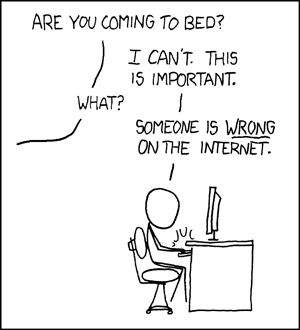
This famous 2008 cartoon from xkcd says it all.


The most important thing to remember when you encounter unpleasantness is: take a breath, verify facts, and don't over-react. As Bob Mayer said on his blog last week: "The internet is a very dangerous place. I’ve seen internet lynch mobs go crazy over the slightest thing (done it myself a time or two) but a day or two of waiting and watching isn’t going to change anything."

When cybermonkeys start tossing verbal feces around a forum or blog, treat it like any other pile of poop.
  • Carefully walk around it.
  • Realize you don't have to tell anybody what it is. Its stink will give it away.
  • Call maintenance.
  • Go someplace cleaner.
You might want to send private messages of support to victims, but don't stand up for victims in cyberpublic no matter how much your inner Atticus Finch is hurting to speak.

I didn’t follow that advice recently and I'm still scraping stuff off my shoe.

Rule #7 Stay Out of Rough Neighborhoods


Absolute Write is no longer recommended. I used to suggest looking there for info on bogus agents and scam publishers. These days, it's so dominated by bitter, bad-tempered snark, you'd probably be safer with the scammers.

Amazon Forums: The Deadwood of the publishing frontier. Brutally anti-author and out of control with vigilantism.

LinkedIn Writers Groups. Some may be safe, but I've unsubscribed from all the ones I belonged to. Way too many rageaholics. LinkedIn is the most invasive of all social media and if you're not on it because of work, I'd recommend you stay away. They'll try to trick you into giving them access to all your email accounts so they can spam every one of your contacts mercilessly in your name, including every agent you've ever queried.

Goodreads: Mean Girls meets Lord of the Flies. This site has been desperately in need of adult supervision for a long time. Recently, they have made big steps in cleaning up the site, but I'd still suggest you stay in safe, author-oriented groups. (I'm fond of my BoomerLit group.) And don't read your reviews!

Or, to be really safe, follow the advice one agent tells her clients: "Go to Goodreads to put up an author profile. Link to your blog. Log out. Never go back."

Rule #8: Change your definition of "review" and don't take online reviews so seriously


1) An online product review is nothing like a traditional book review. When most of us think of a book review, we think of something in the New York Times, or a thoughtful assessment of a work written by a sincere blogger who has read the book and done some careful thinking and writing about it.

But online product reviews—as established in the early days of the Internet—are essentially comments, like the comments you see at the end of online news stories or a You Tube entry.

That means some online "reviewers" bear the same resemblance to traditional book reviewers that homicidal baseball fans do to sports commentators: not much.

2) Cruel, angry reviews say more about the reviewer than they do about your book. And they put you in excellent company.  I know yours hurt like a physical wound, but it helps to read some of the idiotic one-stars of the classics.

3)  It's an urban myth that Amazon requires a certain number of reviews or stars or "likes" on your author page to "move you up the ranks." Only one thing does that: sales.

Some advertising newsletters like Kindle Nation Daily, E-Reader News Today and BookBub do require tons of 5-star reviews, but I think that encourages gaming the system so I use advertisers that don't, like E-Book Bargains UK.

For actual readers, it's much more important to have a few good reviews and some good editorial reviews from well known authors. So don't obsess.

4) A lot of people view retail site reviews as a place for comic relief. Some can be hilarious. Actor George Takei recently made "top reviewer" status on Amazon for his reviews of odd products. I dare you not to laugh.

Others can be morbid and weird, like the Yelp reviews of the hotel where a body was found in the water cistern, or reviews of a wife-killer's "self-help" books.

5) Bad reviews don't always mean bad sales. One young writer engaged in an ill-advised snark battle with an ex that ended up in getting her book over 100 one-star nasty, racist reviews. But her book seems to be selling briskly.

6) Amazon also has an ultra-competitive "top 500/100/50 reviewer" program and you can get caught in their games. According to many reports, Grand Theft Auto mentality is rampant there. Reviewer-on-reviewer bullying and competition can be toxic. I've seen them use review comments and "useful" voting buttons to harass each other. Or they give one-stars to books their rivals love. With the author or vendor getting caught in the middle.

This is obvious breach of Amazon rules, so clicking the "report abuse" button usually solves the problem, but it can be traumatizing for the baffled author.

There is a rigid Amazon review culture and fall afoul of it at your peril. I've just heard of a new book about it called How to Get Good Reviews on Amazon by Theo Rogers, which may explain some more of the arcane rules.

7) Most people who write product reviews and comments are sincere, helpful customers, and some Amazon book reviewers are old school literary experts who could be published in any upscale magazine.

The best way to clean up the review system is add your honest reviews to the mix. Join the ranks of the sincere and helpful! 

I know sometimes it seems as if nastiness on the Interwebz is getting worse, but according to some, it's actually turning around. In the May 2013 issue of Esquire, Stephen Marche said: "The Internet has reached peak hate. It had to. At every other moment in history when there has been an explosion of text — whether through social change, like the birth of a religious movement, or technological change, like the advent of print — a period of nasty struggle ensued before the forces of civility reined it in."

Let's hope for those forces of civility to step in soon.
***

Please don't discuss any specific recent incidents of bullying in the comments, or we'll attract monkey-poo (and if you see it, don't respond. Let it stink for itself.)

But don't keep bullying stories to yourself. Lawyers, law enforcement, and journalists are collecting information and will be grateful for your input. You can leave an incident report for NBC news here. There's more info at the International Bullying Prevention Website.

What about you, scriveners? Do you think Internet can be civilized? What other rules should writers follow to stay safe? Can you recommend other safe places for writers? Know of any other bad neighborhoods we should avoid? Do you think retailers should drop the "star" system on online reviews?


Book Bargain of the Week

Food of Love: a comic thriller about dieting, chocolate, and a small nuclear bomb.

Part thriller and part screwball romantic comedy, Food of Love is a rollercoaster comedy that also addresses complex issues about body image, religion and a woman's right to choose.
Usually $2.99, now only 99c on Amazon , Amazon UK and NOOK


"This hilarious page-turner packs a profound satirical bite. It's a Hollywood romp that provides romance, mystery, and an honest confrontation with the human condition. Food of Love is a funny and powerfully healing book." ...Lucia Capacchione, PhD, bestselling self-help author, Recovery of Your Inner Child

Opportunity Alerts

Looking for an editor? Are you an editor? Sign up for GalleyCat's Freelance Editor Directory
As a service to the writers and editors in the GalleyCat audience, they are building a free, automatically updated directory where editors can post their services and writers can seek freelance editors. It's FREE. GalleyCat is one of the top resources in the publishing industry.

Become a Certified Ghostwriter! with the only university level course in ghostwriting. Designed to expand or launch lucrative, professional careers, this course meets online Mondays from 5:30 - 8:30 PM Pacific beginning Oct 14, 2013. Certification at the end of the two semesters is conferred by California State University, Long Beach.

Boomers!! The Huffington Post's Huffpo50 is now publishing short fiction! The rules: You must be 50 or older to enter. Writers can submit only one story per year, and all pieces must be 5,000 words or less. Send your original submissions, as well as your contact details, to 50fiction@huffingtonpost.com.

Get your book international visibility for a reasonable price. EBUK
is now advertising bargain books to a dozen countries, including the US and Canada. You can get more info here. Make sure your book is under $3.99 and provide links to all stores, not not only Amazon (unless you're in Select.) Ads are a little over 10 bucks until the end of August. And you can sign up for the newsletter for your country right here. I've signed up for the new US version. If you like bargain ebooks, this is a great free service.

Military Sci Fi Anthology. VFW: Veterans of Future Wars from Martinus Publishing. Write Military stories? Could one of them be set in the future? This is the anthology for you! 2000-6000 words. Make sure to follow submission guidelines. No docx files. Deadline Dec. 31, 2013.


***

This month Anne has an article about the pressures social media puts on authors at Talking Writing, the magazine for creative writers and readers.


First, an awesome announcement: this blog will be named to Writer's Digest's Best 101 Sites for Writers in the May-June issue! (special thanks to Lila and Janet for the heads-up.) We are so jazzed! The magazine should be in stores soon. Subscribers have already got their copies. Many, many thanks to whoever nominated us!! 

To celebrate this exciting news, my publisher has made all my mysteries 99 cents until the end of April. That's at Amazon and Barnes and Noble. This includes The Gatsby Game Food of Love, and the Camilla Randall Mysteries, either as the boxed set or singly, and No Place Like Home, usually $4.99 (still only at Amazon, alas.) Click those links or click through the book covers in the sidebar. Here's my author page at Barnes and Noble.

And Ruth Harris has joined in, making her Park Avenue Boxed Set only 99 cents as well. (That's 33c a book!) 


OK, we hear about them all the time, but what the *%@# are algorithms, anyway?

An algorithm is a line of code that gives a search engine a step-by-step process to produce a desired result: like a list of websites, a bra that fits, or a suggestion for the next title to put on your TBR list.

They aren't new. In fact they were invented in the 8th century AD by a Persian guy named Abū ʿAbdallāh Muḥammad ibn Mūsā al-Khwārizmi . The word "algorithm" or "algorism" is a corruption of his name: al-Khwarismi.

But in the digital age this venerable type of formula has taken on a huge importance for the marketplace. An algorithm can make or break sales of any product online. As superstar author Hugh Howey said in an interview on Reddit, “I'm guessing 90% of my sales are from reader recommendations and Amazon algorithms.”

Or as his interviewer called them "the inscrutable Amazon algos."

They're sure not scrutable to me. I'm pretty sure they have to do with math, at which I suck. Seriously. I had to be counseled for “math anxiety” in high school.

Besides, algorithms aren’t that easy to define—even for the people who work with them. The Wikipedia article says, “While there is no generally accepted formal definition of 'algorithm,' an informal definition could be 'a set of rules that precisely defines a sequence of operations.' For some people, a program is only an algorithm if it stops eventually; for others, a program is only an algorithm if it stops before a given number of calculation steps”

Yeah, right. If you’re like me, your eyes have started to glaze over already. Secretly, I think of them as little robot elves who get things done inside my computer.

Like bringing up 64,300,000 links in .52 seconds when you put the word “algorithm” into Google’s search window.

Pretty durn clever, these elves. And kind of Big Brothery. They're what Facebook uses to analyze your “Likes” and figure out if you’re gay, conservative and/or smart.

They’re not infallible. They're responsible for sending you those emails from Amazon suggesting you buy or review your own book, and they're the reason you got spammed with dozens of ads for refrigerators after you accidently Googled “fridge” instead of “fudge” last week.

But they work well enough that businesses increasingly depend on them. A new online lingerie retailer, True&Co, uses a questionnaire and an algorithm to sell mail-order bras—a product that’s difficult to fit even in real-life dressing rooms. According to the NYT, at True&Co “women end up buying more of the bras chosen by the algorithm than the ones they select themselves.”

As you might imagine, online book retailers depend heavily on algorithms to get books in front of the people who might buy them.

David Gaughran talked about the complexity of Amazon’s algorithms in making Amazon’s bestseller lists on his blog, Let’s Get Digital.

“Amazon has a bevy of Bestseller Lists, all split into Free and Paid listings. The big one is theTop 100 in the Kindle Store, and placement on this list can drive staggering amounts of sales. This list is populated with items ranked #1 to #100 in the overall Kindle Store, which includes not just e-books, but also things like games, magazines, and newspapers.

The exact algorithm Amazon uses to assign a Sales Rank to each book is a closely-guarded secret, but the general make-up is easy to deduce. Simply put, your Sales Rank tells you how many books are selling more than you at this moment in time (it’s updated hourly). However, it also takes account of historical sales. More recent sales are weighted much more heavily in the algorithm, though, and velocity plays a big part too (how much your sales are increasing at that moment in time). There’s a lot more to it, but those are the basics.”

David talks more about how Amazon’s algorithm-driven recommendation engines work in a post from February 2013.

But the most important thing to know about the algorithms book retailers use is that they CHANGE. Those robot elves are programmed by real people—who are constantly inputting new data.

Mark Coker changed algorithms at Smashwords last year to encourage authors to stop devaluing their work by giving away so many free books.

Mr. Coker said, “At Smashwords, up until January of this year [2012], our algorithm for best sellers just looked at absolute downloads, but authors gamed that system by offering discounted or free books using the Smashwords coupon tool. So we changed our algorithm to focus on gross sales, so now when you look at the Smashwords best seller list, you’re looking at absolute dollar sales, which we are using as a representation of the interest of customers.”

Amazon changes its algorithms more often than Smashwords. Which means a whole lot of the “rules” you hear about how to sell big on Amazon are based on algorithms that no longer exist.

If you're in the indie author scene, you've no doubt heard a ton of rumors about what the Amazon algorithms will reward or penalize. You’ll hear that more than 50—or 100—“likes” will get more recommendations, or any 3-star or lower reviews will exclude you from the also-boughts or downgrade your author rank. Or that uploading from a non-US country downgrades your status, or dissing Amazon in their forums will be reflected in your sales ranking. Some of these may be true or may have once been true, but they’re hard to prove. And trying to game them generally isn't a good idea.

That's because the one thing we do know for sure about algorithms is that Amazon does not like it when you try to game them.

Which is probably why the Zon is removing the “like” buttons and “tags” on US buy pages. Every author group I belong to asks people to “like and tag” each other’s book pages whether or not the books are in a genre you read or enjoy. Which means the “likes and tags” no longer have meaning for tracking a person's individual preferences, which was the point in the first place.

Even though nobody can know for sure how the “inscrutable algos” are programmed, Amazon watchers can tell when there’s been a change. Some people make a serious study of them.

With the advent of KDP Select—Amazon’s program for books they have exclusive rights to sell—the algorithms were changed to benefit Select members. Select books get more weight in the popularity lists, more suggestions for “also bought” books, e-mail recommendations, and are featured when somebody searches the genre. That makes sense. When you ask for an exclusive, you need to give perks.

Now there’s an even more privileged “White Glove” program for books that have been “self-published” through a literary agency. It has a longer exclusive period and gets the benefit of even more also-boughts and other promotions.

Nothing wrong with that. It’s Amazon’s store and they can promote what they want. But it does make it harder on the truly self-published and small-press competition.

The “Kindle Revolution” that Amazon sparked in 2009 allowed individual authors to self-publish cheaply and gave them an equal opportunity with big publishing’s authors to get discovered. This was a brilliant way of providing a lot of inexpensive books for their brand new Kindle at a time when most people didn’t even think they needed an ereading device.

It was win/win. Amazon sold Kindles—and individual authors got to enter a marketplace that had been reserved for big corporations for half a century.

In doing that, Amazon shook up the book world and did a service to new authors that was pretty unprecedented.

But since then, Amazon has become a publishing company itself. Their Thomas and Mercer, 47North, Montlake Romance, and other imprints now compete with the Big 5. They also compete with the indies. Guess who the algorithms are likely to favor? (I did mention the elves are smart?)

Meanwhile, Amazon's competition as a retailer continues to grow. Kobo and Apple are gobbling up market share. Like any big business, the Zon wants to dominate the competition and keep its place as Alpha Dog of the online retail business.

So they’ve made it very appealing for authors to sell exclusively through them—both with their KDP Select and White Glove program.

And last month they bought Goodreads. We still have to see how that will affect self-and small-publishers. David Gaughran thinks it’s a boon to authors. But some others, like Jarek Steele, and The Author's Guild —not so much. But Mr. Coker saw a silver lining: a way of thwarting people who try to manipulate the elves with paid reviews. For a nice, balanced overview of the argument, read Porter Anderson's piece in Ether for Authors at Publishing Perspectives.

The one thing people agree on is that Amazon wanted Goodreads' data to feed its algorithms. As Gaughran says “Amazon’s recommendation algorithms will be vastly improved with all the data that Goodreads has been collecting.”

So is it true that the Amazon algorithm elves are no longer friendly to indies? Do they only like you if you publish through them, or have an agent—or at least give them an exclusive?

I think it's clear that multi-platform indies are not in the Zon's A-list any more.  I’m not sure we’ll see as many 100% self-pubbed authors reach the heights that Amanda Hocking and John Locke did in the heady early days of the "Kindle" revolution. But indie books by previously traditionally-published hybrid authors are still breaking records. And agents are still trolling the Amazon bestseller lists.

Indies are also hurt by the Big Six books that are being offered as cheaply as indies. (There have been amazing giveaways of big name author’s books, especially in the UK. And this week I saw Barbara Kingslover's iconic novel The Bean Trees for $1.99)

Some people think this all means that the self-publishing revolution is dying.

But the fact is, the trend to self-publishing and boutique digital press publishing is not only alive and well, but growing.

This is because Big Publishing has done nothing to change their attitude that the publisher/author relationship must be one of master/slave. They have made themselves less attractive to new writers with ever more draconian contracts and demands that authors hire publicists and provide expensive traditional marketing with their own funds while the publisher risks nothing, sometimes offering no advance.

The fact that Amazon aspires to become a big publisher itself may make Amazon less attractive for the truly independent author.

But the door to successful self-publishing has been opened and it’s not going to close. The Zon may no longer be the fairy godperson of indie self-publishers, but it's not the Great Satan, either.

And more important:  it's not the only game in town. Amazon now represents less than 50% of the ebook market.
  • A huge number of readers prefer to read on their iPads, which makes the Apple store a big contender.
  • 50% of Apple ebook sales are outside of the US, where the Zon is not always revered, due to a habit of tax dodging. 
  • Kobo has a growing share of the international market, plus Kobo ereaders are selling in indie bookstores, which gives indie authors a chance to reach readers through old-time word-of-mouth, in-store promoting. 
  • The moribund Barnes and Noble/Nook store is undergoing a major overhaul with the new Nook publishing. Those who fear change say it's a disaster, but many in the know say it's much more user friendly and heralds new and forward thinking from Nook, which is still a player in the ereader market. 
  • Plucky little Smashwords is expanding all the time. They are the only way for non-US writers to get uploaded to region-specific sites like Barnes and Noble, so they are becoming more and more useful to indies all over the world. 

Self-and small press published authors who want to be on top of the next trend need to spread their marketing to all platforms, instead of spending all their time courting the Amazon algorithms with freebies and/or organizing armies of fellow authors to give likes and tags and fake reviews.

Launching a book in Amazon's Select program still seems to be a good move. (It works for me, anyway) but after the first three to six months I think most writers need to spread out to other platforms and promote there.

What we do not want to do is keep repeating what worked when the algorithms were the BFFs of the indie authorpreneur and the word "Kindle" was synonymous with "ereader".

The  Indie "Kindle" Revolution may be fading, but the Indie Digital Revolution is still in a dynamic and robust infancy.

What about you, scriveners? Have your sales been affected by the changes in algorithms? Have you heard rumors that you need to do certain things to keep on the good side of the Zon elves? Do you miss the "likes" and "tags"? Do you fear the indie revolution is petering out? 

UPDATE: There is now an algorithm that writes poetry. See, I said those elves are smart! The New York Times now has a Tumbr site where they post algorithm-written haikus based on news stories, called Times Haiku. Here's my favorite. (From an article on Margaret Thatcher's legacy.)

But we are British
So most of us stood around
In awkward silence. 

OPPORTUNITY ALERTS:

1) Readwave: A showcase for short stories: ReadWave is a community of readers and writers who love to discover and share new stories from contemporary writers. Readers can access thousands of stories and read them for free on mobile or desktop--and writers can use ReadWave to build up a fanbase and market their stories online. ReadWave has created a new reading widget, that allows bloggers and website owners to embed stories online in a compact form. The ReadWave widget is the first reading widget to allow readers to "follow" the writer. When a reader follows a writer they are added to the writer’s fanbase and can receive updates on all of the writer’s future stories. ReadWave puts writers in touch with the readers that are right for them. This looks like a great innovative site. You know how I've been encouraging you to write more short fiction? This is where to put it to start building a fan base.

2) The Saturday Evening Post’s Second Annual Great American Fiction Contest—yes, THAT Saturday Evening Post is holding a short fiction contest. Could you join the likes of F. Scott Fitzgerald; William Faulkner; Kurt Vonnegut, Jr.; Ray Bradbury; Louis L’Amour; Sinclair Lewis; Jack London; and Edgar Allan Poe? $10 entry fee Deadline July 1, 2013

3) Inspirational anthology accepting submissions: A "Chicken Soup for the Soul" author is looking for heartwarming inspirational nonfiction pieces. Do You Have a Story on "Staying Sane in the Chaotic 24/7 World"? If you have a great story and would like to be considered for the anthology, 30 Days to Sanity, Send submissions to: 30 Days to Sanity at Box 31453, Santa Fe, NM 87594-1453. Or e-mail stories to stephanie@30daystosanity.com The maximum word count is 1200 words. For each story selected for the program a permission fee of $100 will be offered for one-time rights. There are no limits on the number of submissions. Deadline is May 1, 2013

4) Stanford Story Slam The first ever Stanford Story Slam has opened, a chance for a team of writers to win $500. Anybody can enter. To enter, you must collaborate to write about this prompt: “There are over 15,000 bikes used by students, staff, and faculty to get around Stanford campus. Over 300 bikes are stolen each year. Where do they go?” The Stanford Arts Review will publish the winning entry. Here’s more from the organizers You don't have to be a Stanford student to enter. Deadline is April 22.

5) The 35th annual Nimrod Literary Contest: The Pablo Neruda Prize for Poetry and The Katherine Anne Porter Prize for Fiction. The Awards offer first prizes of $2,000 and publication and second prizes of $1,000 and publication. One of the oldest “little magazines” in the country, Nimrod has continually published new and extraordinary writers since. For more information about Nimrod, visit their website at www.utulsa.edu/nimrod. Deadline is April 30th.